
To most people, a chickadee is a cheerful flash of black, white, and gray flitting through winter branches, punctuating the cold with its familiar “chick-a-dee-dee-dee.” But to Dr. Jeff Lucas, professor at Purdue University, that tiny 10-gram bird carries one of the most sophisticated communication systems known in the animal world, and a powerful story about how habitat disruption reshapes life in ways we rarely notice.
Dr. Lucas, who studies animal communication and auditory processing, has spent decades elucidating how chickadees communicate, how they hear, and how changes in the landscape alter not only where they live but also how they behave, socialize, and survive.
A Bird With a Surprisingly Complex Voice
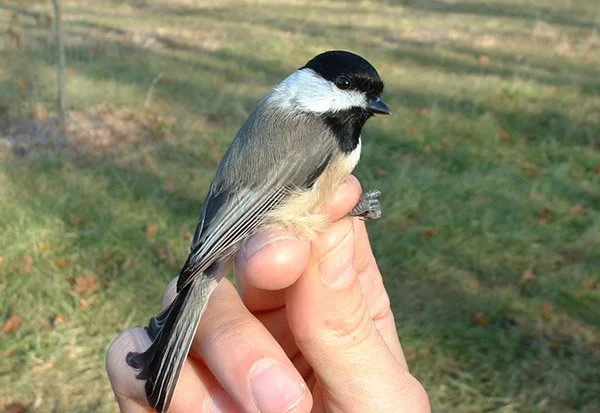
Carolina chickadee
Chickadees belong to a family of birds that includes titmice and tits, all of which produce versions of the well-known chickadee call. But the Carolina chickadee, in particular, stands out. “They have one of the most complicated vocal repertoires of anything we know, which is astonishing for a bird that small.”
Unlike many birds with relatively fixed calls, chickadees use a rich combination of tones, frequency changes, and timing to communicate detailed information. Their vocal system enables them to signal a range of signals, from predator threats to foraging opportunities and social status.
This complexity, Lucas explained, is not accidental. It is deeply tied to their unusual social system.
Summer Families, Winter Coalitions
In spring and summer, chickadees behave much like other songbirds. Pairs raise young within well-defined territories, feeding their chicks and defending their space. Then fall arrives, and everything changes. “At the end of summer, parents essentially kick their kids out.”
What happens next is remarkable. Adult chickadees from several neighboring territories merge into a single winter flock. Overnight, birds that once only needed to communicate with a mate and offspring must now navigate defense, foraging, cooperation, and dominance within a much larger social group.
“That sudden social complexity creates the need to talk about a lot of things. And we think that’s why their vocal repertoire is so diverse.” Young birds may either drift together in loose groups or wait for openings in established dominance hierarchies when older birds disappear, a dynamic rarely seen in other species.
When the Forest Changes, So Do the Birds
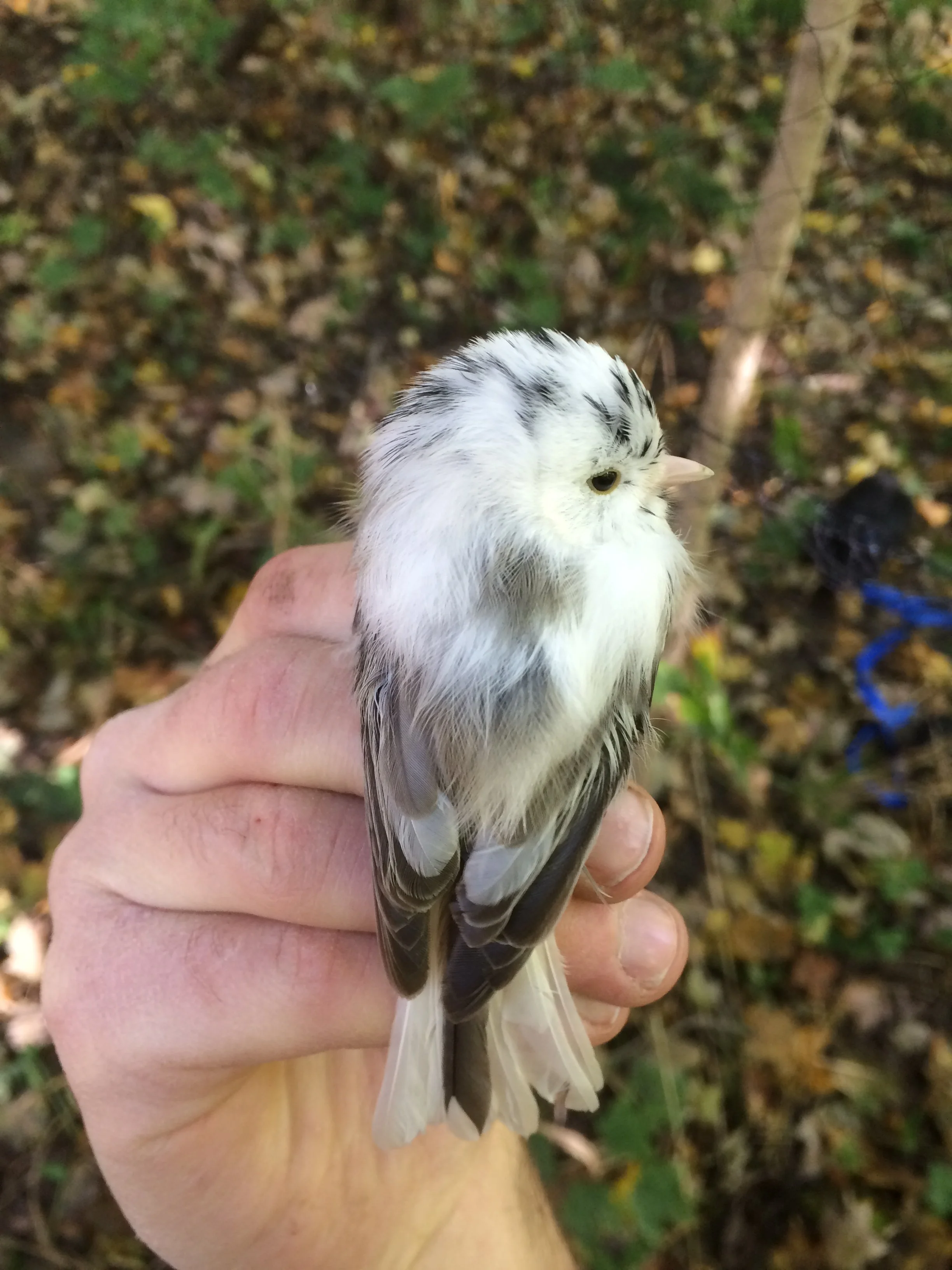
The only albino chickadee Dr. Lucas has seen in 38 years
Lucas and his colleagues have studied chickadee populations across a gradient of forest disturbance, from high-quality, intact woodlands to heavily altered landscapes. In undisturbed forests, chickadees maintain tight territories and stable social structures. But in areas where forests have been logged or converted, such as sites replanted with walnut trees, everything shifts.
“To a chickadee, a walnut tree is basically a boulder. It doesn’t provide food.” In these degraded habitats, territoriality disappears. Birds range over much larger areas, forming what scientists call fission-fusion flocks, where individuals associate with different birds from day to day. This flexibility may help birds find food, but it comes at a cost. “If there’s nothing worth defending, territoriality isn’t useful. So they spend more time foraging and less time defending space.”
Trust, Caching, and Winter Survival
One of the hidden consequences of habitat disruption involves food caching, an essential survival strategy for chickadees. Chickadees regularly store seeds in thousands of hidden locations, retrieving them later when food is scarce. But caching only works if a bird can trust its territory. “If you don’t have a territory, you can’t trust space, and if you can’t trust space, caching stops being useful.”
Without reliable caches, winter survival becomes more difficult, especially during snow or prolonged cold. Even common species such as chickadees, Lucas noted, are subtly affected when their social systems unravel.
Hearing the Seasons: A Shape-Shifting Auditory System
Beyond behavior, Dr. Lucas’s research revealed something even more surprising: chickadees’ auditory systems change with the seasons. His lab was the first in the world to demonstrate that birds reconfigure how they hear depending on the time of year. In spring and summer, their auditory system is tuned to process tonal songs used in mating. In fall and winter, it shifts to better detect the rapid, complex chickadee calls essential for flock coordination.
This discovery was accidental. “We thought our data were wrong. The results disappeared when we added more birds, until I realized half were collected in spring and half in fall.” What began as confusion turned into a breakthrough now recognized across vertebrates, including fish, birds, mammals, and humans. “When estrogen levels are high, the auditory system is better at detecting fine details. That’s true across species.”
Song, Culture, and Indiana’s Fragmented Forests
Chickadee songs are not hardwired. Like human language, they are learned, making them a form of culture. In central and southwestern Indiana, Lucas has documented substantial variation in chickadee songs, attributable to habitat fragmentation. “Indiana used to be a closed-canopy forest. Now, high-quality habitat often exists as ribbons along rivers.” These ribbons allow song variants to persist and evolve, even if they arise from mistakes or experimentation. Some populations transpose songs across pitch levels with precision; others do not. “We don’t yet know what all that variation means. But it’s mind-numbingly complex.”
Atherton Island and a Living Laboratory
Lucas’s work has brought him to Atherton Island Natural Area, now protected by Ouabache Land Conservancy. He was introduced to the property through Jim Nardi. Lucas collected chickadee calls there and found that birds on the island behave differently from those in other parts of the region, yet another reminder that place matters. “These populations are shaped by their landscape, and Atherton Island is a beautiful, important piece of that puzzle.”
Why This Matters to Everyone
For those who wonder why any of this matters to daily life, Lucas offered a simple answer. “Being outside in green space improves quality of life. And the more complex the ecosystem, the more valuable it is.”Birds move seeds, shape forests, and maintain ecological relationships that humans depend on, often invisibly. Disrupting those systems doesn’t just remove species it erodes the integrity of the entire landscape. “If all the chickadees disappeared tomorrow, the government would still exist. But the quality of the world around us would decline in subtle but profound ways.”
Understanding the Pieces to Protect the Whole
Lucas sees his role not as an advocate telling people how to live, but as a scientist helping others understand how the world works. “The integrity of a habitat depends on the associations among all its parts. From fungi to trees to birds to mammals.” Protecting land through organizations such as the Ouabache Land Conservancy, he believes, safeguards not only scenery but also the delicate social and sensory systems that enable ecosystems and people to thrive. “The more we understand what we’re seeing when we step outside, the richer our lives become. And that matters not just for us, but for the generations that follow.”